PayNow for restaurants and F&B: QR payments without the fees
Most restaurants in Singapore accept three or four payment methods. Cash. Cards. GrabPay or FavePay. And sometimes PayNow. Each one costs something different. Cash costs nothing but creates reconciliation headaches. Cards cost 1.5-3% in merchant discount rate (MDR) plus terminal rental. GrabPay and FavePay take 3-5% commission per transaction. PayNow costs nothing. It is a direct bank-to-bank transfer, and it is the only common payment method in Singapore that charges zero fees to the merchant.
The problem is that most F&B businesses treat PayNow as an afterthought. They tape a generic QR code to the counter, the customer has to type in the amount, and nobody can tell which table or order the payment belongs to. That is not how PayNow should work in a restaurant.
What restaurants are actually paying in fees
The numbers are straightforward. Take a restaurant doing $30,000 a month in sales. Here is what each payment method costs:
| Payment method | Fee structure | Monthly cost on $30,000 | |---|---|---| | Cash | None (but counting, storing, banking time) | $0 direct | | Card terminal | 1.5-3% MDR + $30-80/mo terminal rental | $480-980 | | GrabPay / FavePay | 3-5% commission | $900-1,500 | | PayNow | None | $0 |
If even half your GrabPay volume shifted to PayNow, you would save $450-750 a month. Over a year, that is $5,400-9,000 back in your pocket. For a hawker stall or small cafe, that is a meaningful number.
The irony is that customers already have PayNow. Every Singapore bank account supports it. The customer scans a QR, confirms the amount, and the money arrives in your account within seconds. No app download, no wallet top-up, no commission.
Why most restaurants do PayNow badly
Walk into any coffee shop or restaurant that accepts PayNow and you will likely see one of two setups. Either a printed SGQR sticker on the counter from the bank, or a handwritten sign saying "PayNow to 9XXXXXXX."
Both of these are open-amount QR codes. The customer scans, types in whatever amount they think is correct, and sends. The restaurant has no way to know which table paid, whether the amount is right, or which order it matches to. Staff end up checking the bank app manually after every payment, scrolling through a list of incoming transfers looking for the right amount.
This is the reason many F&B owners think PayNow is more trouble than it is worth. It is not PayNow that is the problem. It is using the wrong type of QR code.
Fixed-amount QR codes change the workflow
A fixed-amount PayNow QR encodes the exact dollar amount and a reference (like a table number or receipt number) directly into the QR code. When the customer scans it, the amount is already filled in. They just confirm and pay. No typing, no mistakes, no guessing.
Here is what a proper PayNow workflow looks like in a restaurant:
- Customer finishes their meal. The bill is $47.50 for table 6.
- Staff generates a PayNow QR for $47.50 with reference "Table 6" or the receipt number.
- The QR is printed on the bill, shown on a tablet, or sent to the customer's WhatsApp.
- Customer scans with their banking app, sees $47.50 pre-filled, confirms.
- Money arrives in the restaurant's bank account within seconds.
- The bank notification includes the reference, so staff know which table paid without checking.
Compare that to the current setup at most restaurants: customer scans an open QR, types in $47.50, maybe types $47 or $48 by mistake, staff checks the bank app to verify, and nobody knows which table the payment came from until they match it manually.
Table tents and menu QR codes
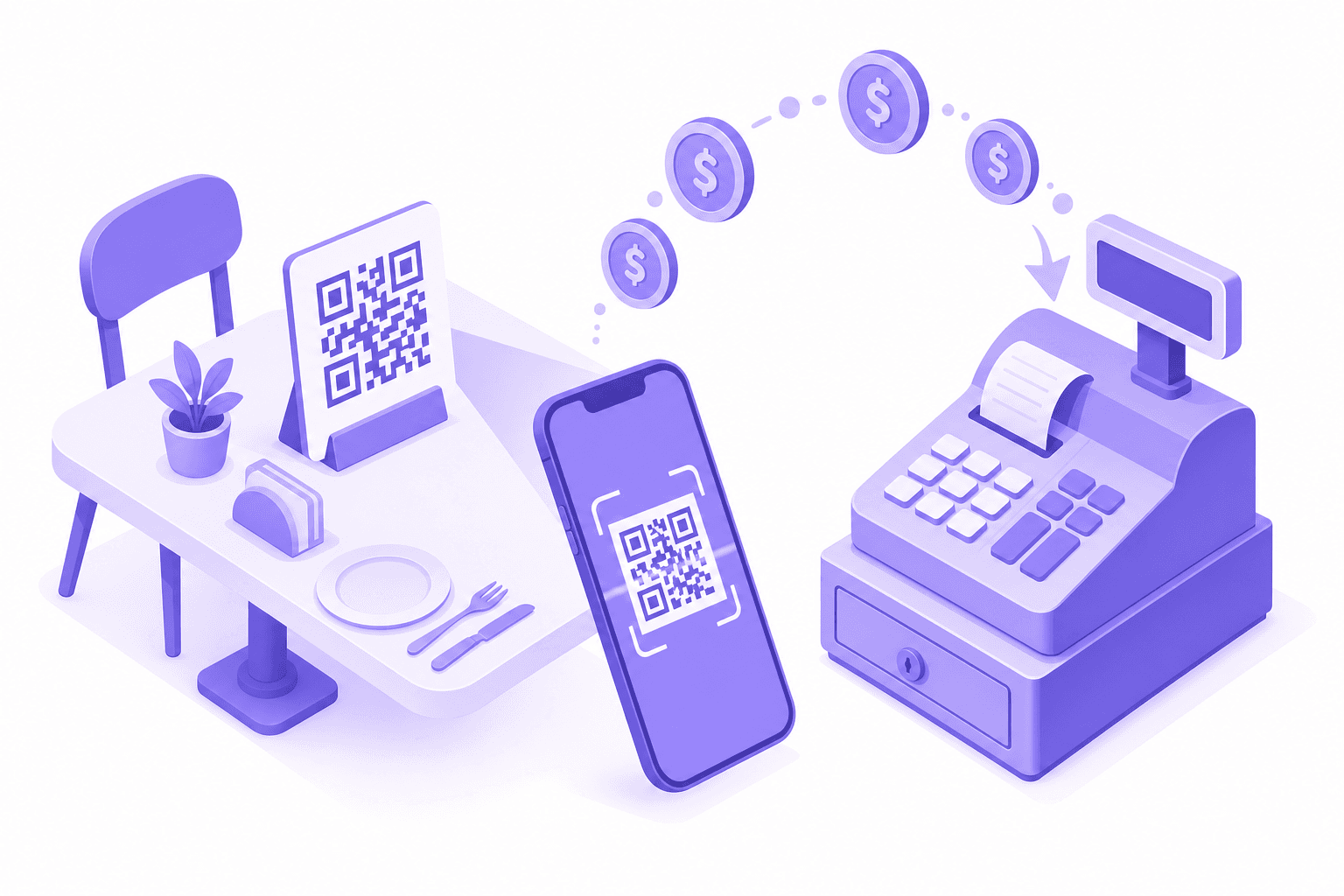
Some restaurants go further and put fixed-amount QR codes directly on the table or menu. This works well for places with a limited or fixed-price menu.
A set lunch at $12.90? Print a PayNow QR for $12.90 on the table tent. The customer scans and pays without waiting for the bill. A hawker stall with five items? Five QR codes on the menu board, one per price point.
This is already common in parts of China and Southeast Asia with other payment systems. PayNow supports the same thing. The main barrier is that generating fixed-amount QR codes one at a time through the bank app is slow. Most bank apps require you to go through several screens to create a single fixed-amount QR, and there is no way to batch them or save templates.
Generating QR codes at scale
If you run a single stall and collect ten payments a day, generating QR codes through your bank app one at a time is manageable. If you run a restaurant with 50 covers a night or a multi-outlet chain, it is not.
The DoubleAM PayNow QR generator creates fixed-amount QR codes with your reference built in, and works with any Singapore bank. You enter the amount and reference, get the QR, and send it to the customer on WhatsApp or print it. The money goes to your own bank account. DoubleAM does not hold or process the payment.
For higher volume, the PayNow API generates QR codes programmatically. A POS system, ordering app, or even a simple spreadsheet can call the API to create a QR for each order. The reference ties back to your internal order number, so reconciliation is automatic.
How this compares to GrabPay and card terminals
The comparison is not about which is "better" in absolute terms. It depends on what your customers use.
| | PayNow QR | GrabPay / FavePay | Card terminal | |---|---|---|---| | Cost to merchant | $0 | 3-5% per transaction | 1.5-3% MDR + terminal rental | | Settlement | Instant | 3-7 business days | 1-3 business days | | Customer needs | Any bank app | GrabPay/Fave wallet | Physical card | | Hardware needed | None | None (but Grab tablet for POS) | Terminal | | Works offline | No | No | Yes (some terminals) | | Refunds | Manual bank transfer | Through Grab dashboard | Through terminal |
The gap is in the cost column. A $50 meal through GrabPay costs you $1.50-2.50 in commission. Through PayNow, it costs $0. If you serve 100 customers a day and half pay through GrabPay, that is $75-125 a day in commission. Shifting even a portion of that to PayNow saves real money.
Cards and GrabPay still have their place. Some customers prefer them, and you should not remove payment options that customers want. But if you are not actively offering PayNow as an option, you are paying commission on transactions that could have been free.
What PayNow does not do
PayNow is not a POS system. It does not track inventory, manage tables, or split bills automatically. It is a payment rail. The money moves from the customer's bank to yours, and that is it.
If you need a full POS with PayNow built in, that is what Qashier and similar systems offer (though they charge 0.8%+ on PayNow transactions for the privilege). If you just need to collect payments without fees, PayNow QR handles that on its own.
Refunds are also manual. There is no "void transaction" button. If a customer overpays or wants a refund, you transfer the money back through your bank. For most F&B businesses, this is rare enough that it is not a problem. For high-volume operations with frequent refunds, a POS system with integrated refund handling may be worth the cost.
Getting started
If you already have a business bank account in Singapore, you likely have PayNow available. You just need to register your UEN with PayNow through your bank. If you have not done that yet, read our guide on how to set up a PayNow business account.
Once your UEN is registered, you can start generating fixed-amount QR codes. The free PayNow QR generator works with any bank, adds your reference, and lets you send the QR on WhatsApp. No signup, no fees.
If you want to add PayNow to your website for online orders, or you need dynamic QR generation through an API for your POS or ordering system, see the PayNow integration and pricing page.
The payment infrastructure is already there. Every customer with a Singapore bank account can pay by PayNow. The only question is whether your restaurant makes it easy for them to do so.
Last updated: July 2026. GrabPay commission rates (3-5%) and card MDR rates (1.5-3%) are based on typical Singapore merchant rates as of this date. Actual rates vary by provider and agreement.
Frequently asked questions
Register your business UEN with PayNow through your bank (DBS, OCBC, UOB). Then generate a QR code linked to your UEN. You can print a static open-amount QR for the counter, or use a tool like DoubleAM PayNow to generate fixed-amount QR codes per order with table or receipt references built in.
Yes. A fixed-amount PayNow QR encodes a specific dollar amount. You can generate one per menu item or per set meal price and print them on table tents, menus, or order sheets. DoubleAM's PayNow API can generate these dynamically so you do not have to remake them when prices change.
No. PayNow is a direct bank-to-bank transfer. There is no merchant discount rate, no percentage fee, and no settlement delay. The money arrives in your bank account within seconds. Some third-party tools that process PayNow on your behalf may charge fees, but a direct PayNow transfer does not.
GrabPay is a wallet. The customer pays from their GrabPay balance, Grab takes a commission of 3-5% per transaction, and settles the funds to your account on their schedule. PayNow is a bank transfer. The customer pays from their bank account, there is no commission, and the money arrives in your account instantly.
Your bank app can send a push notification when money arrives. A fixed-amount QR with a table, receipt, or order reference also makes the transfer easier to match in your bank records. DoubleAM generates the QR and reference but does not process the payment or claim to replace your bank's transaction notifications.